At a Glance
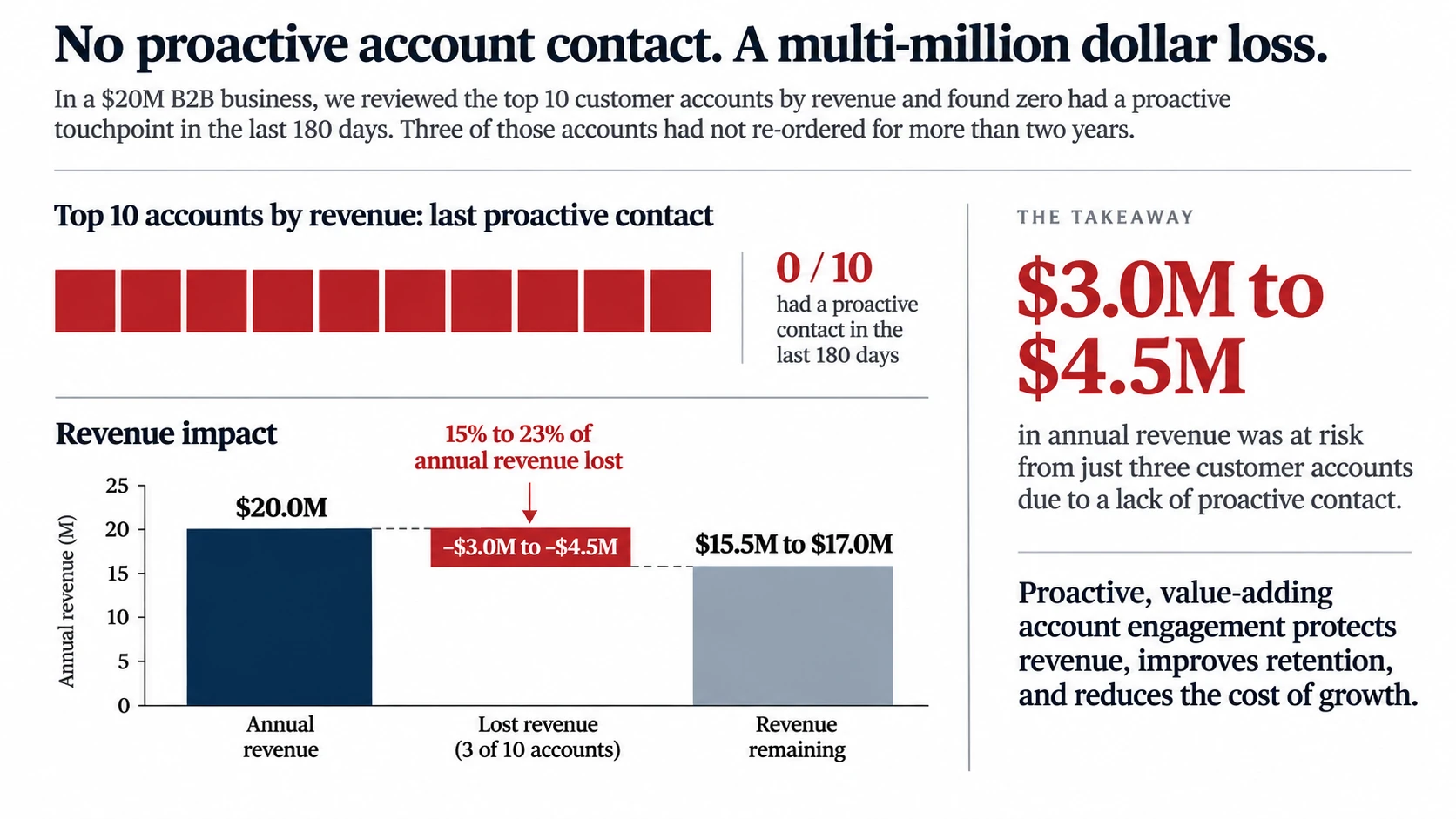
We went through a client’s top 10 customer accounts by revenue. Zero had a touchpoint in the last 180 days, and three hadn’t reordered in two years.
We went through a client’s top 10 customer accounts by revenue at the beginning of this year... and zero had touchpoints in the last 180 days. Three of them hadn’t re-ordered for two years even though they had typically ordered once per year historically. That was millions in expected reorders that were built into projections, and no one even noticed until we looked.
At the beginning of this year, we kicked off a new client with a typical deep dive on everything about their business. The story that they told us was that their business had been built on relationships and care for their customers, which isn’t unusual for a lot of businesses their size. You can imagine the shock on their faces and the dead silence in the room when we pulled up the zero number.
And no one on the team had any arguments to make about that because, for the first time, someone checked the actions behind the relationship statement. Orders came in and good work went out, but nobody had a reason to call in between. For years, the quality of the work was enough to bring customers back. But now that’s working less as AI gives “good enough” answers and “good enough” alternatives that seem right on the surface to prospects. They might find out later the AI was wrong and costly, but later doesn’t prevent someone from churning now.
And to put more math behind that number. In a $20M/year B2B non-subscription type business, typically the top 20% of customers make up 50-75% of total revenue (from our data of over 100 CRMs in the last couple years). If 3 in 10 (30%) of those quietly churn each year, you’re losing $3M to $4.5M, more if your largest accounts are the ones that leave. Then you have to make that up with net new customers or expansion.
The reason this happens is because many, many businesses have allowed expertise to take the full place of service. You need both. But what is service?
Service is the proactive nurturing of a relationship, without the expectation of an equal return. Being human for the sake of being human. Giving even when it is unearned. Ironically, when this is done, you do actually receive a large return. The return just comes in various ways and on a longer timescale.
Over-relying on expertise
The expertise angle is so ingrained you might not even notice its weight in your team psyche. When we asked the team of our client why their customers go to them in the first place, we got answers like “they were the best at engineering the solution”, “they guided their customers to the best solution”, “they responded quickly to inquiries”, and “they had high quality” which were all true. But that’s true for a lot of other companies, and even more so with the introduction of AI, where you can masquerade as having a high enough level of all these things.
What was missing from every answer was anything personal. Nobody mentioned the authentic personal relationship between the purchaser and the team. The kind where both sides keep bringing up that one funny story that had nothing to do with business. Where two humans share a cherished, shared memory.
That’s how we know the reliance on expertise has gone too far. Firms and people within firms have leaned too heavily on the expertise and knowledge angle. Efficiency, repeatability, and speed were what got rewarded and became the dominant ethos while doing business. The act of service became a lost art.
We were no exception to this. Internal discussions about prospects, clients, and projects all centered around transactional topics and metrics. It wasn’t the feeling of how I wanted to do business or how our team wanted to do work. There has to be balance between service and expertise.
Now, this imbalance has smashed head on into AI. Which zapped the energy from the overreliance on expertise as a differentiator. The answer to this is opposite of what AI is providing. It’s the refocus around long term value creation, which means long-term, ongoing partnerships (service).
So how do we do this? How can we stop treading water with quiet churn from our biggest customers?
- Look at your top 10 accounts by revenue over the last 12 months. Are there touchpoints every 90 days that add value and don’t have strings attached?
- Look at your response time. Do you respond to inbound customer emails, texts, and calls within a day or sooner? Just a simple acknowledgement is what’s needed.
- Occasionally go the extra mile to make a stellar experience. Count how many times you’ve clearly done this in the past year for your top accounts. It should be 1-2 times. Less than that won’t make it feel special. More than that is too much and causes an imbalance in the relationship.
- Have the account owner explain their top 3 accounts. What do they do, what are the top 2 challenges they’re facing, and how would they fix it. What you’re trying to get to is if you’re treating your clients’ businesses like they’re your own.
So to solve this “silent churn” problem, humans have to care and connect regularly. Then you can prevent your top paying clients from leaving without a trace.
How are you getting back to true service?