The RevOps Maturity Model for Professional Services Firms
Most maturity models were built for software companies. In a services firm, people are the product, and revenue only shows up when the right people are on billable work and the invoice actually gets paid. Use this one to see where you stand and what the next level looks like.
Most maturity models assume a funnel feeding a subscription. A services firm doesn't work that way.
The published models from HubSpot, Gartner, and others grade useful things: process, data, technology, alignment. They just miss the four things that decide whether a services firm makes money.
You can only sell what you can staff.
SaaS models treat demand as the only limit on growth. In a services firm, the limit is your bench. Sales and staffing have to move together.
Margin gets made or lost in delivery.
Utilization, realization, your junior-to-senior mix, and revenue per employee decide your margin, and none of them show up in a funnel report.
A bad estimate loses money before the work starts.
Services are sold as a scope and a price. If the estimate is wrong or the SOW is loose, the project bleeds no matter how well the team delivers.
Current clients are both your easiest growth and your biggest risk.
The easiest new revenue is expansion during delivery. And one client over 25% of revenue puts the firm and its valuation at risk.
We score four pillars, each on five levels, and every one of them treats selling and delivering as one system.
Same structure we use in every engagement. What changes is what each pillar measures. For firms of roughly 50 to 300 people, Level 3 to 4 is the realistic target.
How deals match your team's capacity, how work gets scoped and priced, and how signed work turns into cash.
Founder or partners sell ad hoc. Nobody checks whether the team can staff what's being sold. Scopes priced by gut, SOWs inconsistent or verbal. Invoicing is reactive and nobody watches how long clients take to pay.
Documented sales stages and a standard SOW template. Pipeline gets reviewed, but not against team capacity. Rough estimation templates. Billing on a cadence, DSO tracked.
Pipeline reviewed against the bench in planning. Estimates built from what past projects actually took. Change orders enforced. Milestone billing, DSO managed to a target.
Deals weighted by how likely they are to close and whether you can staff them; staffing pre-committed on late-stage deals. Estimates checked against actuals and fed back. Billing triggers automated, collections risk flagged early.
Demand, capacity, and pricing rebalanced continuously. Prices flex with demand and available capacity. Scope risk priced in. Cash comes in with almost no manual chasing.
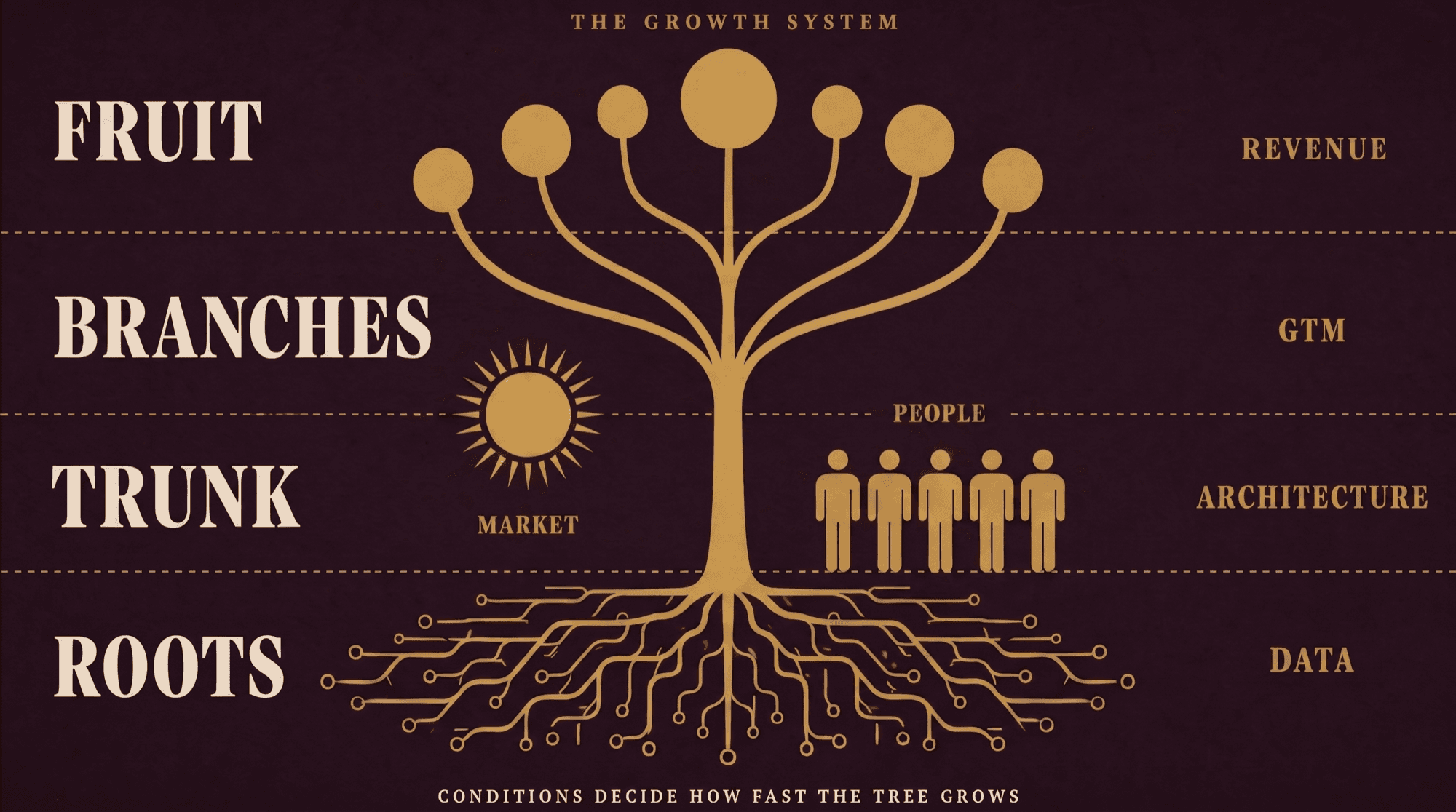
Each pillar maps to part of the Growth Tree, so a low score shows you where the problem actually lives.
It's the same tree we use in every engagement, so the diagnostic speaks one language from the first call to the final readout.
Data quality, time and project data capture, hygiene
How CRM, PSA, and finance connect; how won deals hand off to projects; how SOWs turn into invoices
How sales matches team capacity, how delivery people sell, how accounts grow
Utilization, realization, margin, revenue per employee, and a forecast you can staff
Revenue is the fruit, which is why every engagement starts at the roots.
The pillars are the tree. Growing Conditions are everything around it: the people who tend it and the market it's planted in. We check those before we recommend any work on the tree.
People
The right seats filled, leadership that holds people to the process, capacity to run what gets built, and incentives that don't fight it. The rainmaker who keeps every contact in his head and shares nothing isn't a pillar problem: he's weather.
Market
Demand, positioning, and fit with the clients you want. We assess it because it shapes the plan, and if the problem is the market, a CRM project won't fix it. We'll say so.
How this differs from the Enablement pillar: Enablement measures how your people sell and staff the work. Growing Conditions asks whether the right people, backing, and market are there at all.
Whether you sell projects or retainers changes what good looks like.
Same pillars, same levels. A project-led consultancy and a retainer-led agency just weight them differently.
Project-Led
Consultancies, advisory firmsRevenue comes in lumps, project by project. Matching sales to available staff matters most; repeat clients and expansion smooth it out.
Often steep pyramids where junior staff drive margin. Boutique strategy shops may be partner-only.
Value or fixed-fee plus time and materials. Most of the risk sits in the estimate.
Relationships and referrals; the people who deliver also sell. Standard demand-gen advice applies less.
Present but spread across engagements.
Retainer-Led
Agencies, MSPs, managed servicesRetainer-heavy and more recurring, so retention math looks closer to SaaS.
Mixed seniority; less of a pyramid.
Retainer plus project work plus media markup. Under-delivery risk spreads across the retainer.
More marketing-led pipeline and a dedicated new-business function.
Often higher; depending on one anchor account is common.
Score your firm in ninety seconds.
Rate each pillar 1 to 5 on a typical week, not your best one. Hover a number to see what that level looks like in practice, then answer five yes/no questions about the people and backing around the system.
Most teams score themselves a level too high.
The Growing Conditions check
Pillar scores measure the tree. These five questions measure what's around it. The first two can't be bought, only decided.
One person owns the revenue number and has the authority to change how the team works.
Leadership will hold the team to the process, not just approve the project.
The key ops seats are filled: someone runs CRM and marketing/sales ops day to day.
There is capacity to maintain what gets built, after the build is done.
Comp and incentives reward working the process, not around it.
Revenue depends on heroics; margin and cash are blind spots.
A 14-day HubSpot cleanup first, then a build that starts at data and architecture.
Documented and visible, but not yet tied to capacity or predictive.
A build aimed at moving your weakest pillar up one level.
Measured and tied to capacity; the forecast is reliable.
One level of work, aimed at the pillar that's lagging.
The sell-and-deliver system improves itself.
Advisory work: rebalancing, analytics, multi-company rollups.
When the conditions are the problem, that's its own piece of work.
It looks at both sides: people (seats, leadership backing, capacity, incentives) and market (demand, positioning, fit). You get a straight answer on whether system work will hold right now, and a plan for the gaps. Run it on its own or as the first workstream of a build.
When we score you, we pull the numbers. Every level has a threshold you can measure.
Every threshold comes out of HubSpot, the PSA, or finance data. You score at a level when you clear its thresholds and every level below it.
| Pillar | Level 2 threshold | Level 3 threshold | Level 4 threshold | Level 5 threshold |
|---|---|---|---|---|
| Process | Documented stages in CRM; standard SOW template in use; speed-to-lead tracked | Stage hygiene ≥90%; required field completion ≥90%; speed-to-lead under 1 hour; enforced change-order process; DSO ≤45 days | Estimate-to-actual variance within ±10%; billing triggers automated; collections risk flagged before due date | Pricing and staffing rebalanced continuously against live demand and capacity signals; scope risk priced into every SOW; collections require no manual follow-up |
| Enablement | At least one revenue source besides the founder; expansion revenue tracked as its own pipeline | Founder-sourced revenue below 50%; account plans on top 10 accounts; leverage targets set by service line | Expansion pipeline per account manager; realization coached against per-person data | New business sourced with no founder involvement; junior-to-senior mix tuned as a standing practice; expansion is the largest single growth line |
| Insights | Utilization and realization reported monthly at firm level; client concentration calculated | Utilization, realization, and margin by person and service; largest client below 25% of revenue; resource-loaded forecast in place | Forecast variance tracked against actuals; leading-indicator alerts live (bench risk, realization erosion, scope creep) | Staffing, pricing, and deal-selection recommendations generated from live data; revenue per employee and margin tracked against target in real time; concentration held below threshold by design, not by exception |
| Systems | CRM is the single source for pipeline; time tracking compliance ≥90% weekly | CRM-PSA-time tracking integrated with no duplicate data entry; automated deduplication on | Bi-directional CRM-PSA-finance sync; sell-and-deliver dashboards near real time | Full analytics across CRM, PSA, and finance in a single layer; data hygiene and enrichment run automatically; executives can step back from day-to-day sales and delivery for months without the system drifting |
Level 1 means you don't yet clear the Level 2 thresholds. Stage hygiene, required-field completion, and speed-to-lead are hard gates. The rest are our default targets, tuned per engagement. No client has been taken through Level 4 or 5 yet, so those two columns describe what a firm has to clear, not a result we've already produced.
Moving Between LevelsYou move up one level at a time. Each one has a timeline and a starting price, and we say up front what we expect it to return.
Level 1 to 2 is where we connect the pieces, Level 2 to 3 is where you start to see, and Level 3 to 4 is where you grow. Each move is measured against a baseline we lock at kickoff and re-score when the level closes.
- Connect · Level 1 to 2Reactive to Aligned
State pipeline and revenue at risk with confidence.
Starting at$60,000 - See · Level 2 to 3Aligned to Optimized
Grow revenue without growing overhead at the same rate.
Starting at$120,000 - Grow · Level 3 to 4Optimized to Predictive
Commit a number to the board and hit it.
Starting at$150,000 - Level 4 to 5Predictive to Transformative
Defend valuation and survive a leadership change.
Starting at$300,000
Level 1 to 5 takes about two and a half to three years back to back, and in practice the moves overlap. Nobody buys the whole journey up front. You buy the next level, prove it, then decide.
Seven numbers every services firm should be able to pull.
These sit behind the Insights pillar, and they're the first thing a diagnostic pulls. If your systems can't produce them, that by itself tells us where to start.
Billable utilization
Share of available hours on billable workHealthy firms run break-even utilization at 50-60%. Break-even above 70% signals structural problems.
Realization rate
Revenue captured vs standard-rate value of work doneLow realization exposes scope creep, write-offs, pricing pressure, and a delivery-to-finance disconnect.
Leverage
Ratio of junior to senior staff (the delivery pyramid)Higher leverage lifts margin when juniors bill above their cost. Track the mix by service line.
Revenue per employee
Total revenue divided by headcountThe metric most correlated with firm valuation. Partner-only boutiques near $600K; full-service agencies near $180K.
Project gross margin
Profitability after direct delivery costConfirms pricing held and scope stayed intact.
Days sales outstanding
Time from billing to cashFlags friction in billing, acceptance, or collections.
Client concentration
Revenue share from the largest clientAbove 25% in one client is an existential risk and can depress sale valuation by 15-30%.
Now you know roughly where you stand. Let's look at where you can get to.
A guided diagnostic scores all four pillars from your real HubSpot, PSA, and finance data, then shows you the one move to make next. Three weeks, $15,000, credited in full if you go ahead with the build.
Schedule a conversation